Interior designer in Paris
Interior Designer Paris: High-End Interiors by Rodolphe Parente
Paris is one of the most demanding cities for interior design. Projects often sit inside historic envelopes (Haussmannian, early 1900s buildings, Art Deco residences), governed by co-ownership rules, access constraints, and tight technical realities. At the same time, Paris is a city where taste is scrutinized, where references matter, and where clients expect a level of finish that feels effortless.
Rodolphe Parente is a Paris-based interior architect and designer who founded his studio in 2009 after several years working alongside Andrée Putman. His practice spans private residences, hospitality (hotels, restaurants), retail and bespoke design, reflecting a “global vision of space” rather than a purely decorative approach.
Why hiring an interior designer in Paris is different
A Paris renovation rarely behaves like a “standard” project. The building dictates the rules: load-bearing walls, chimney breasts, uneven floors, heritage details, and the invisible complexity of networks. The neighbourhood also sets expectations: a Trocadéro apartment, a Left Bank pied-à-terre, and a 10th arrondissement Haussmannian home do not speak the same language.
In practice, a strong interior designer in Paris needs to balance:
- respect for architectural character without turning the home into a period set
- modern comfort (storage, lighting, acoustics, kitchen and bathrooms) without breaking proportions
- craftsmanship and detailing that feel precise but never showy
- long-term elegance rather than short-lived trends
- a plan that works for daily life, not only for photographs
The goal is not to “add style.” The goal is to create a coherent interior where space, light, materials and furniture form a single narrative.
A Paris studio with a comprehensive view of space
Rodolphe Parente’s positioning is rooted in the overlap between interior architecture and design. His official biography highlights the studio’s foundation in Paris in 2009, and his background alongside Andrée Putman. Maison&Objet also describes the studio’s taste for heterogeneity and work across scales: residential, hotels, boutiques and furniture.
This matters for clients because Paris projects often need both:
- architectural intelligence (plan, circulation, built-in elements, spatial rhythm)
- design sensibility (materials, colour balance, furniture, lighting, art integration)
When those two layers are handled separately, interiors can look “assembled.” When they are developed together, the result feels natural.
Paris projects that illustrate the studio’s range
Paris is not a single aesthetic. The most convincing portfolios show variety: classic bones reinterpreted with contemporary moves, bolder modernist statements, and hospitality spaces where atmosphere and flow are critical. The projects below demonstrate that breadth.
Canal Saint-Martin: a Haussmannian apartment refreshed with contemporary notes
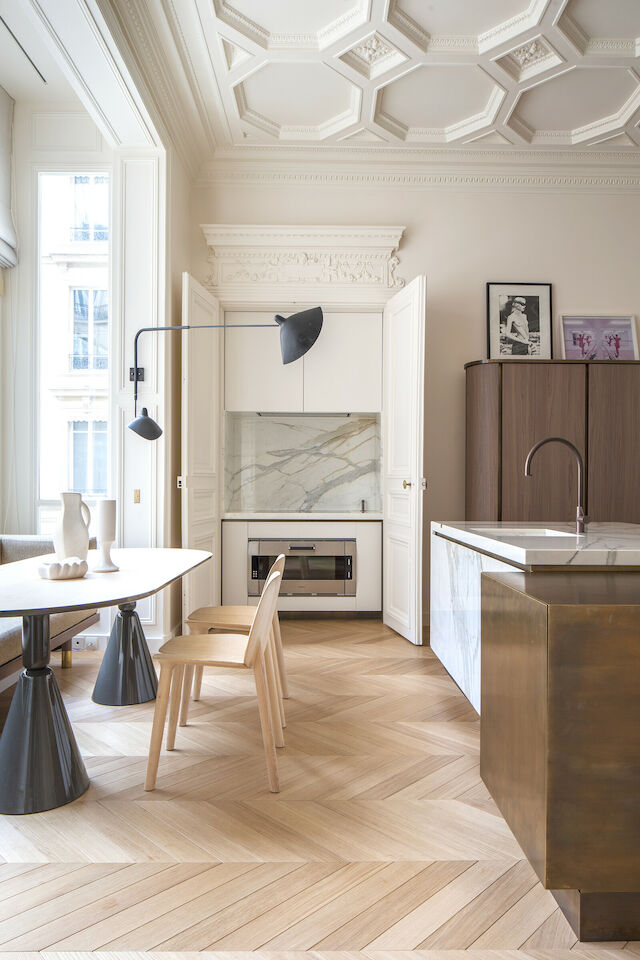
In a Haussmannian apartment near Canal Saint-Martin (Paris 10th), Rodolphe Parente is presented as bringing “freshness” through discreet contemporary interventions, while working within the historic structure.
This kind of Paris project is a strong reference because it answers a common client brief:
- keep the identity of the old Parisian apartment
- avoid pastiche and heavy-handed classicism
- introduce modern comfort and a more personal, collected feel
- create a dialogue between architecture, art and furniture
Yatzer notes that the redesign was commissioned by an art collector and describes an approach that mixes modernist, postmodern and contemporary elements with subtle architectural changes. This is a good example of a Paris interior designer working beyond “decoration,” using design choices to articulate the space.
Trocadéro: a large Paris apartment fully refurbished with an Art Deco base
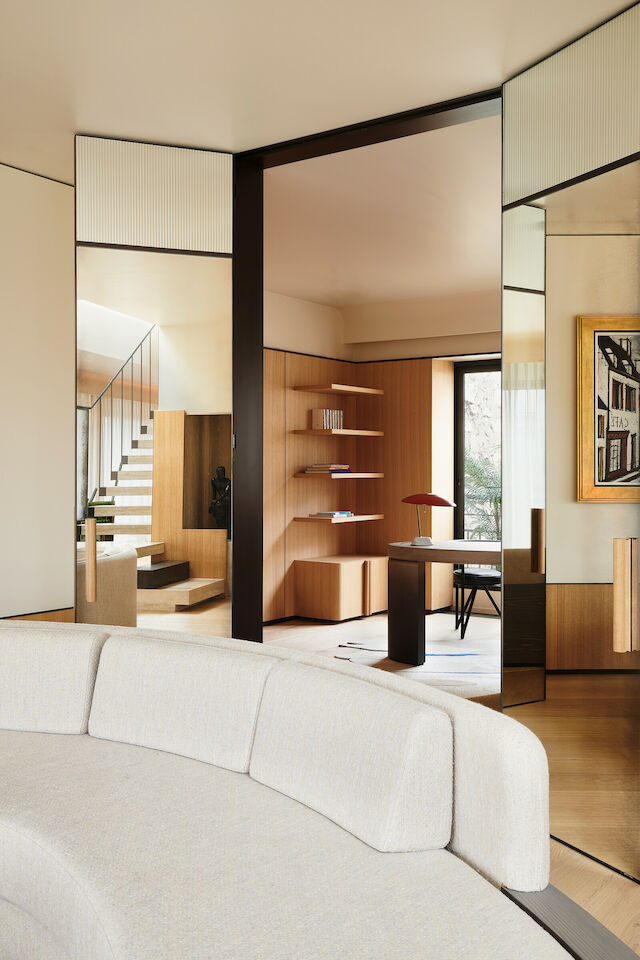
For clients searching “interior designer Paris,” a Trocadéro address signals scale and expectations. The “Private Apartment Trocadero” project is described as a fully refurbished 300m² Paris apartment designed by Rodolphe Parente, mixing the original Art Deco spirit with later 20th-century decorative references.
Large Paris apartments can easily become formal, cold, or overly museum-like. A successful redesign needs:
- a clear rhythm across rooms and corridors
- strong continuity in materials and colour logic
- comfort that feels intimate despite size
- a sense of personality that does not sacrifice timelessness
The Trocadéro reference supports the studio’s ability to handle substantial volumes and to orchestrate style without relying on a single formula.
A Paris “mono-material” statement: concrete, storytelling, and precision
Architectural Digest has also featured a Paris apartment transformation by Rodolphe Parente where the narrative mixes cinematic references with a disciplined architectural approach, including a “mono-material” use of concrete and a highly deliberate spatial atmosphere.
This type of project demonstrates another side of the studio’s Paris work:
- bolder conceptual choices
- an emphasis on architectural cohesion
- a willingness to reshape the interior’s identity rather than simply “update” it
For some clients, the best interior designer in Paris is not the one who repeats a familiar Parisian look, but the one who can create a strong, singular space with real architectural intent.
Paris hospitality: Yeeels, a restaurant and bar on Avenue George V
Paris-based interior design is not limited to private apartments. Hospitality projects are often the most revealing because they demand identity, durability, and flow under pressure.
Yeeels, a Paris restaurant and bar on Avenue George V, is described by Wallpaper as a collaboration between Rodolphe Parente and Benjamin Liatoud, using a palette of luxury materials such as brushed brass, ceramic, onyx, marble and mirrored surfaces. Multiple sources describe Yeeels as a 400sqm space across two floors with contrasting atmospheres.
A high-end restaurant interior succeeds when it balances:
- a strong first impression without feeling theatrical in the wrong way
- lighting that shifts from early evening to late night
- acoustics and comfort that keep guests relaxed
- materials that hold up to intense use while still feeling refined
- circulation that supports service and guest experience simultaneously
Yeeels functions as a Paris reference that supports the studio’s ability to build “destination” interiors, not only residential ones.
What “high-end” means in Paris interiors
Luxury in Paris is rarely about excess. It is typically about calibration:
- the right proportion of historic character and contemporary clarity
- materials chosen for their feel and ageing, not only their cost
- lighting designed as a sequence of moods, not a single layer
- detailing that disappears because everything aligns
- comfort that feels immediate, quiet and obvious
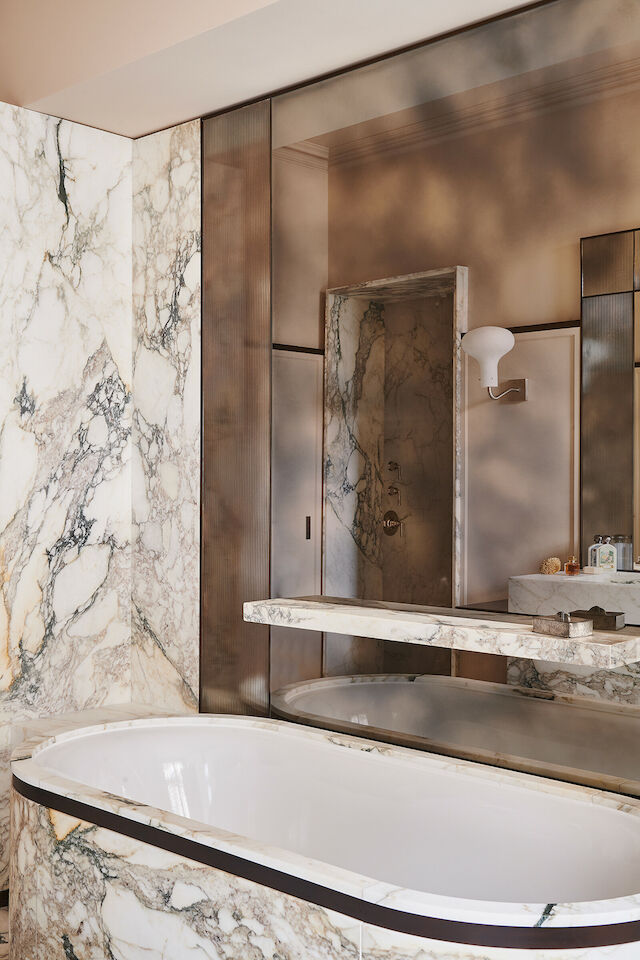
Maison&Objet underlines the studio’s attraction to expressive materials and openness to contemporary uses, which is a practical definition of modern Parisian luxury: sophistication that still works for real life.